Professional insight
Injection Therapy – Precision, Appropriate Dosing and Rehabilitation Matter
An injection may reduce pain or support a treatment pathway, but it rarely solves the problem on its own. New research increasingly points in the same direction: outcomes depend on treating the right structure, using corticosteroid or PRP at an appropriate dose and indication, and helping the patient progress through active rehabilitation.
First, we must know what we are treating
Terms such as “shoulder pain”, “bursitis” and “tendinitis” do not always describe the same condition. Symptoms may arise from a tendon, bursa, joint or several structures at once. An injection should therefore never be a generic response to pain, but a targeted intervention following clinical assessment and, where relevant, diagnostic ultrasound.
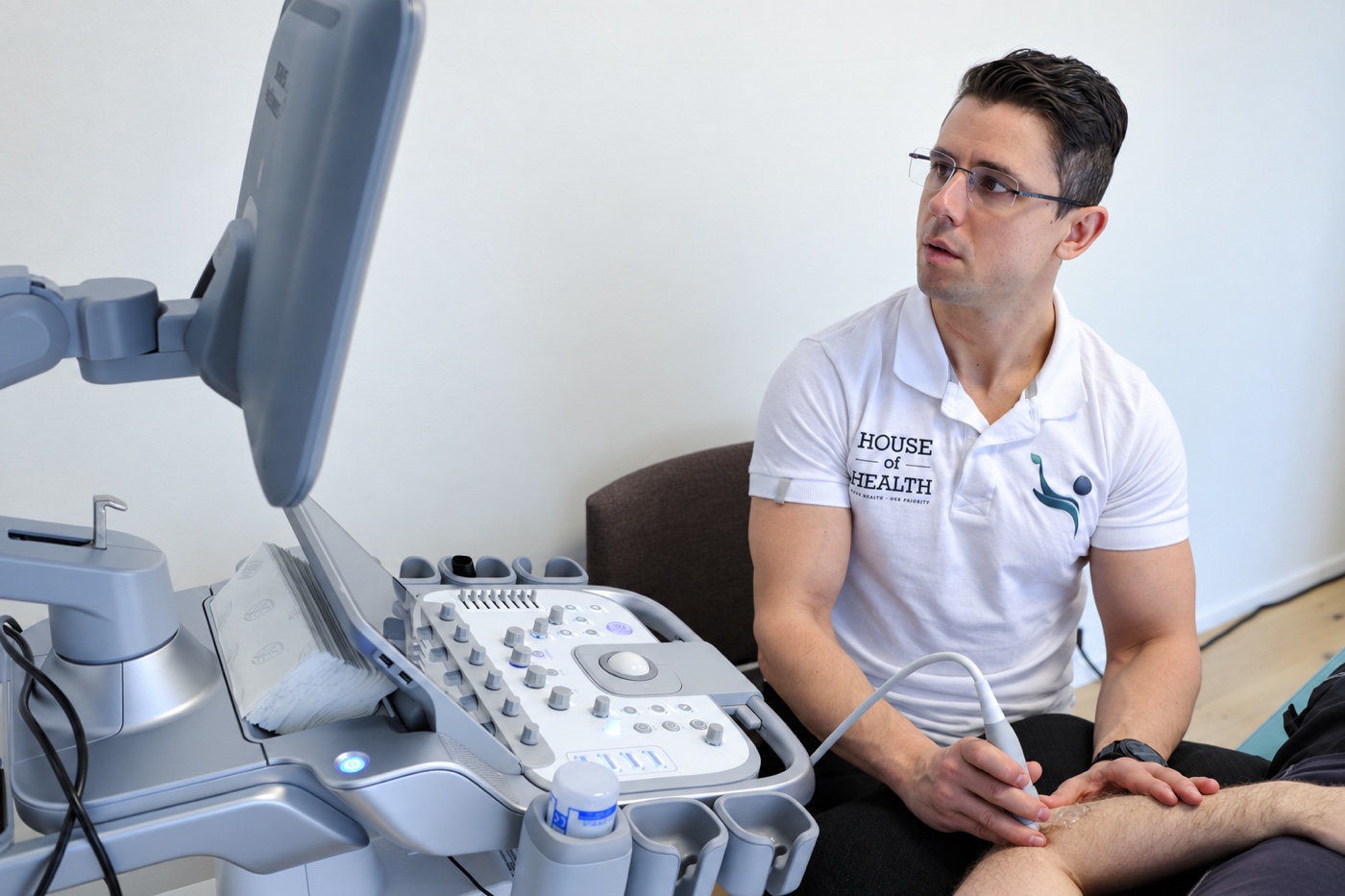
Ultrasound guidance improves accuracy and reduces procedural pain for several musculoskeletal injections. Its diagnostic value is equally important: when findings are explained clearly, the patient understands why a specific structure is being treated, what the injection may contribute and what it cannot do.
More corticosteroid is not necessarily better
A comprehensive 2026 guideline concludes that 20 mg triamcinolone is as effective as 40 mg for both glenohumeral and subacromial bursa injections. For the knee, 40 mg was as effective as 80 mg. The message is important: the aim is the lowest effective dose, not the largest possible dose. Corticosteroid usually provides short-term pain relief lasting weeks to a few months and must be weighed against effects including raised blood glucose, adrenal suppression and possible adverse effects on cartilage and bone.
PRP is not one standard product
PRP is often discussed as if every preparation were identical. They are not. Platelet concentration, total delivered platelet dose, leucocytes, activation and injection volume vary. A large network meta-analysis of 56 trials found that higher platelet or leucocyte concentrations did not automatically improve outcomes in knee osteoarthritis. Another analysis suggests there may be a favourable dose range, without “more” necessarily being better.
This does not make composition irrelevant. On the contrary, PRP needs better characterisation and documentation. It does mean that biological treatments should not be marketed as a general regenerative solution without a clear diagnosis and realistic expectations.
Effect depends on the condition and the time horizon
For rotator cuff tendinopathy, a recent meta-analysis found little difference between PRP and corticosteroid early on, but a modest advantage for PRP at six months. Chronic Achilles tendinopathy tells a different story: placebo-controlled studies show no reliable PRP benefit for pain, function or tendon structure. The same product may therefore be reasonable to discuss for one diagnosis and difficult to justify routinely for another.
Rankings also change over time in plantar fasciopathy. Corticosteroid may provide rapid symptom relief, whereas PRP and some other options may perform better in the medium or long term. The question is not merely “what works?” but “for whom, for which diagnosis, towards which goal and when?”
The injection should create a window for rehabilitation
A new meta-analysis found greater pain reduction when PRP for knee osteoarthritis was combined with exercise than when PRP or exercise was used alone. Certainty was low, however, and a high-quality randomised trial found exercise alone comparable to the combination and better than PRP alone on several functional outcomes. This is not a contradiction to hide but an important clinical point: PRP effects are uncertain and variable, while active rehabilitation remains foundational care.
When an injection reduces pain, that gain should be used for graded loading, strength and a return to activity. Without a plan for what happens next, a temporary change in symptoms risks becoming the whole treatment.
How I work
I begin with a clinical examination and use diagnostic ultrasound when it can clarify the structure involved. If an injection is appropriate, I perform it under ultrasound guidance, using the lowest effective dose or a documented PRP preparation. Before treatment, we agree on the goal, realistic time horizon and rehabilitation plan. Changes in symptoms and function determine whether we continue, adjust or choose another direction.
Sources
- Benzon HT et al. “Use and safety of corticosteroid injections in joints and musculoskeletal soft tissue: guidelines …” Regional Anesthesia & Pain Medicine. 2026;51(7):746–773. doi:10.1136/rapm-2024-105656. Main source.
- Dasdemir KA, Karatas N. “The effect of combined platelet-rich plasma and exercise on pain and function in knee osteoarthritis: a systematic review and meta-analysis of randomized controlled trials.” Disability and Rehabilitation. 2026. doi:10.1080/09638288.2026.2674613.
- Anitua E et al. “Influence of platelet-rich plasma composition on pain and functional performance in knee osteoarthritis: a systematic review and network meta-analysis.” Knee Surgery & Related Research. 2026;38:17. doi:10.1186/s43019-026-00318-4.
- Hooper N et al. “Platelet-rich plasma outcomes in knee osteoarthritis are associated with the amount of total deliverable platelets.” PM&R. 2026;18(2):210–222. doi:10.1002/pmrj.13455.
- Assi C et al. “Platelet-rich plasma vs. placebo injections in Achilles tendinopathy.” Journal of Foot and Ankle Surgery. 2026;65(4):139.e1–139.e5. doi:10.1053/j.jfas.2026.04.005.
- Yuwarungsikul P et al. “Platelet-rich plasma provides modest but durable functional benefit over corticosteroid for rotator cuff tendinopathy.” Knee Surgery, Sports Traumatology, Arthroscopy. 2026. doi:10.1002/ksa.70416.
- Tien YC et al. “Comparative effectiveness of minimally invasive therapies for plantar fasciitis.” Scientific Reports. 2026. doi:10.1038/s41598-026-40038-z.
- Karaborklu Argut S et al. “Does the combination of platelet-rich plasma and supervised exercise yield better pain relief and enhanced function in knee osteoarthritis?” Clinical Orthopaedics and Related Research. 2024;482(6):1051–1061. doi:10.1097/CORR.0000000000002993.
Keywords
- Injection therapy
- Ultrasound guidance
- Corticosteroid
- PRP
- Rehabilitation
- Knee osteoarthritis
- Tendinopathy