Professional
Bursitis – Usually Secondary to Tendon Overload
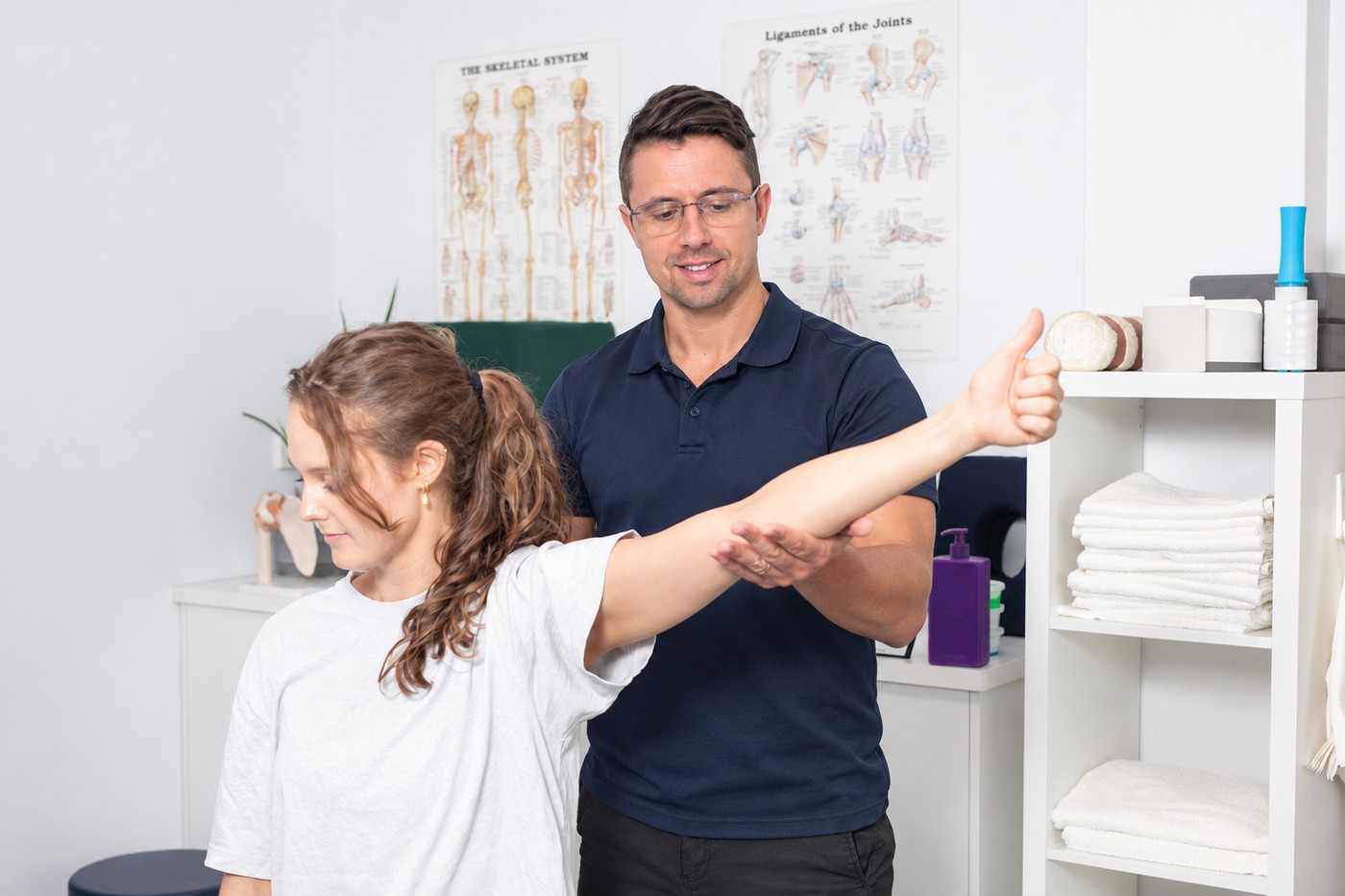
Many people associate bursitis with an isolated inflammation in a bursa, and expect treatment to focus on calming that inflammation specifically. Around the large joints – the shoulder and hip in particular – that's usually an oversimplification that sends treatment down the wrong path. The bursa is most often reacting to something else.
What a bursa actually is
A bursa is a small, fluid-filled sac located where tendons, muscles or skin glide over bone, cushioning the friction of movement. The body has around 160 of these sacs, and most of clinical significance sit close to large joints such as the shoulder, hip, knee and elbow. The bursa isn't an isolated structure – it lies close to, and is often in direct contact with, the tendon insertion it protects.
| Primary bursitis | Secondary bursitis | |
|---|---|---|
| Mechanism | Direct pressure, friction or trauma to the bursa | The bursa reacts to irritation in a neighbouring tendon |
| Typical example | Olecranon bursitis from prolonged leaning on the elbow | Shoulder bursitis with rotator cuff tendinopathy; hip bursitis with gluteal tendinopathy |
| What should be treated first | The bursa itself – offload the pressure point | The tendon – load management and targeted exercise |
Why the bursa is usually reacting to something else
Research on the bursa beneath the shoulder blade's acromion (the subacromial bursa) shows it isn't a passive sac, but a tissue that actively responds to what's happening in the rotator cuff tendons right beneath it. As the tendon degenerates, inflammatory signalling molecules are released that affect the bursa directly, and the degree of bursal reaction may be associated with how pronounced the tendon disease is. This has led several researchers to describe shoulder bursitis and tendinopathy as two expressions of the same underlying process, rather than separate conditions.
The same pattern shows up at the hip: what was long called "trochanteric bursitis" usually turns out to be a tendinopathy in the gluteal tendon insertions, with the bursa as a secondary response. This isn't just an academic point. In one randomised trial, education and exercise produced better overall improvement than corticosteroid injection at both 8 and 52 weeks, although the pain difference was not clear at 52 weeks.
Not all bursitis follows this pattern. Olecranon bursitis often arises from repeated direct pressure – leaning on the elbow over time – and is an example of more genuinely primary bursitis, without a tendon necessarily being the main source. The point, then, isn't that the bursa is never the problem, but that you shouldn't assume it is without examining what's actually driving it.
Early phase: offloading before anti-inflammatory measures
When bursitis is secondary to a tendinopathy, purely calming the inflammation doesn't solve the problem – the tendon that's actually the source remains untouched. The early phase should therefore prioritise offloading the most provocative movements and positions, adjusting daily load, and starting a graded rehabilitation protocol aimed at the tendon. The goal is to settle the irritation to a level the tendon can tolerate building exercise on top of, not to remove all load.
Diagnostic ultrasound as quality assurance
Because bursitis and tendinopathy so often occur together, symptoms alone rarely settle the diagnosis. I always consider diagnostic ultrasound when bursitis is suspected, specifically to clarify whether it's the bursa, the tendon, or both that are affected – and to follow the progression over time if the course doesn't go as expected.
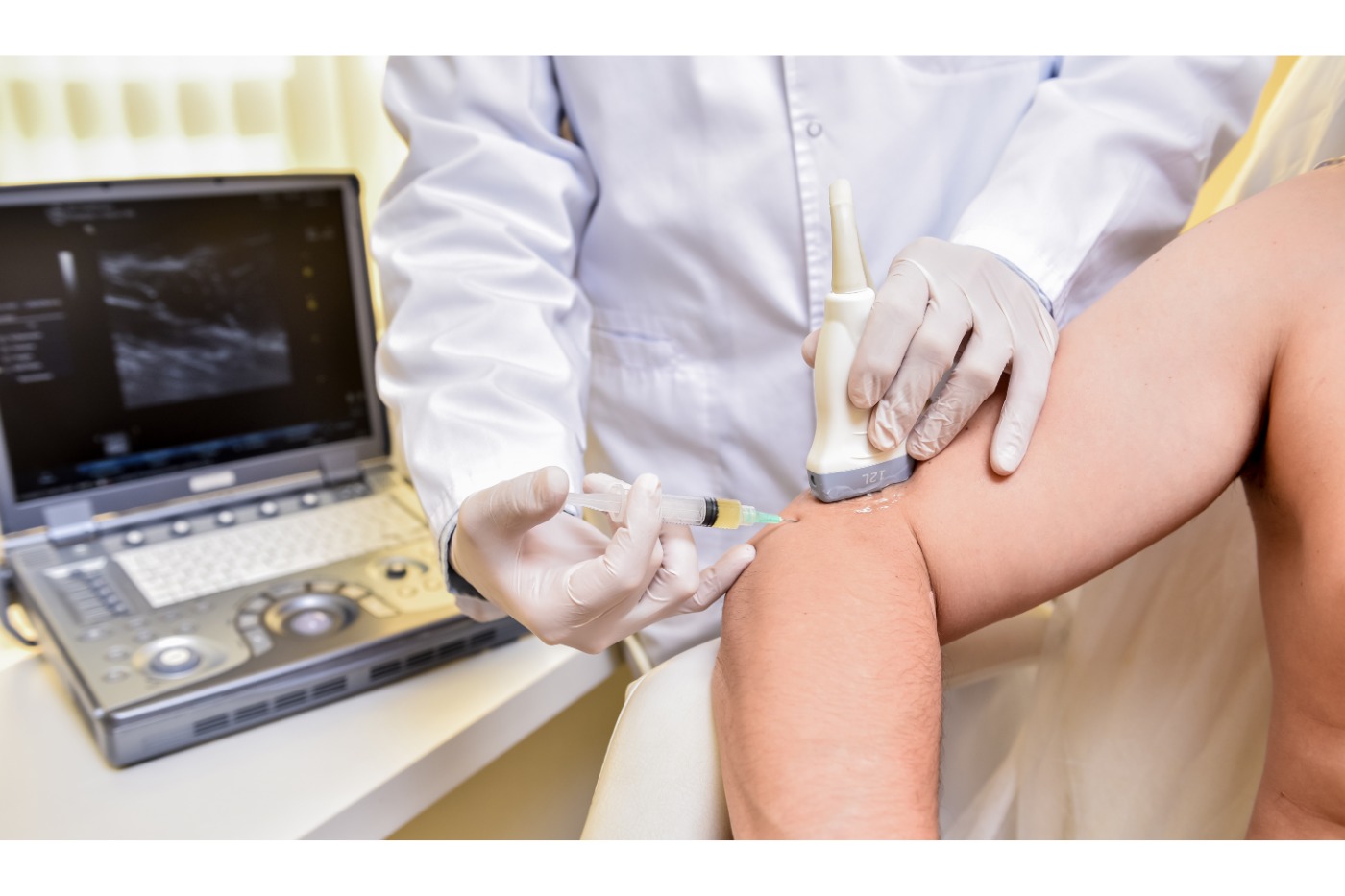
Where a diagnostic block or injection treatment is needed – whether in the bursa, the tendon insertion, or both – I perform this under ultrasound guidance. That makes the block more reliable as a diagnostic tool: if we hit the right structure, the response gives us a clearer picture of what's driving your symptoms.
How we know a measure is actually working
I use your symptom trajectory as the main guide along the way. When something is working – whether it's load management, exercise or an injection – symptoms should at a minimum not worsen, and over time should trend downward. If the opposite happens, and symptoms increase, that's a clear signal the approach needs adjusting rather than continuing unchanged. This simple rule governs how long we stick with a given measure before changing course.
How I work
When bursitis is suspected, I start with diagnostic ultrasound to clarify whether the bursa, the tendon, or both are the source – that determines the entire approach going forward. In most cases we direct treatment at the tendon with offloading and a graded rehabilitation plan, rather than going straight at the bursa. Where a diagnostic block or injection treatment is needed, I perform this under ultrasound guidance, and then follow your symptom trajectory closely to know whether we're on the right track.
Sources
- Klatte-Schulz F, Thiele K, Scheibel M, Duda GN, Wildemann B. "Subacromial Bursa: A Neglected Tissue Is Gaining More and More Attention in Clinical and Experimental Research." Cells 2022;11(4):663.
- Lewis JS. "Rotator cuff related shoulder pain: Assessment, management and uncertainties." Manual Therapy 2016;23:57–68.
- Mellor R, Bennell K, Grimaldi A, et al. "Education plus exercise versus corticosteroid injection use versus a wait and see approach on global outcome and pain from gluteal tendinopathy: prospective, single blinded, randomised clinical trial." BMJ 2018;361:k1662.
- Blackwell JR, Hay BA, Bolt AM, Hay SM. "Olecranon bursitis: a systematic overview." Shoulder & Elbow 2014;6(3):182–190.
- Aly AR, Rajasekaran S, Ashworth N. "Ultrasound-guided shoulder girdle injections are more accurate and more effective than landmark-guided injections: a systematic review and meta-analysis." British Journal of Sports Medicine 2015;49(16):1042–1049.
- Ladurner A, Fitzpatrick J, O'Donnell JM. "Treatment of Gluteal Tendinopathy: A Systematic Review and Stage-Adjusted Treatment Recommendation." Orthopaedic Journal of Sports Medicine 2021;9(7). PubMed.
Topics
- Bursitis
- Tendinopathy
- Bursa inflammation
- Diagnostic ultrasound
- Ultrasound-guided injection
- Manual therapist Oslo
- Shoulder pain
- Load management
- Rehabilitation
- Musculoskeletal problems